
Talen Tools history in timeline

Photo on the left is Klaas Talen Hzn. Photo on the right is the shed in the "goarn.
Klaas Talen
After World War I, Klaas Talen Hzn. looks for work. In 1919, he officially registered as a woodworker. Talen was born in 1894 and married to Geertje de Witte. They had a small farm with a few cows. In a shed in the "goarn," Talen made wooden stems for the scythe trees and hay rakes for the many farmers in his neighborhood. The main tools he used for this were the drawknife and the "wuppe. The wood was cut to a certain length. The split pieces were trimmed with a drawknife to the shape of the desired handle. A highly creative, but also labor-intensive activity.
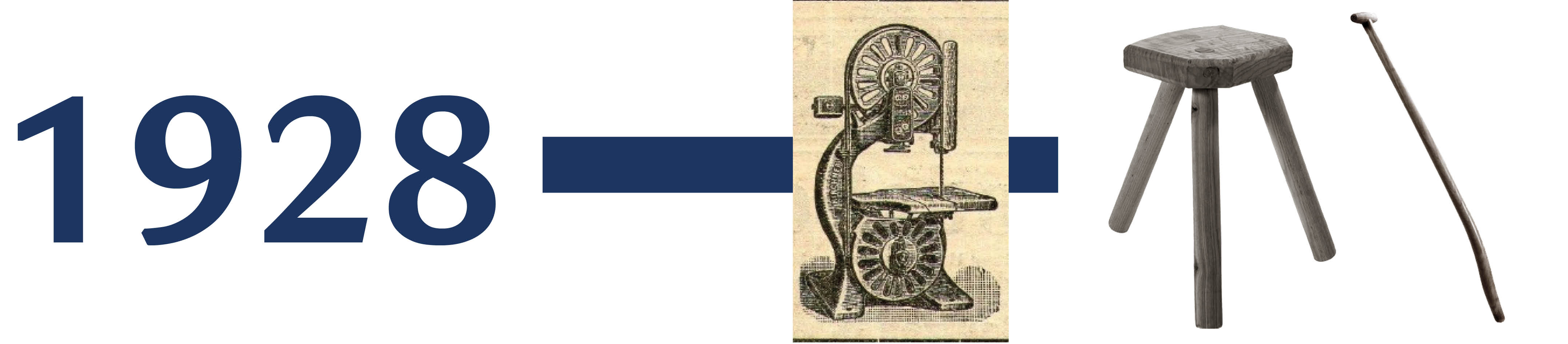

Foto links is een tekening van de elektro-motor. Foto rechts is een melkkrukje.
Electro-motor
In 1928 came the electric motor. The shed was then expanded. Meanwhile Talen also manufactured Staphorster stools and Staphorster tables. The products were taken by cart to Meppel to be transported further by rail. A milk stool cost fl 0.30, but if you bought a hundred, they cost a quarter.
.

Photo on the left is an electro-machine.
World War II
At the beginning of World War II, the Talens buried the electro- machine, fearing German greed. A similar machine currently stands in the hall of Talen Tools. After the war, the machine again takes over the manual work. After
time, personnel also arrived; Jan Schra Hzn. was the first in permanent employment. Harm Coster Ezn. the second.

Photo on the left is Lubbert Talen with the bicycle cart, which he used to transport the bets, Photo on the right is Lubbert Talen drawing out a stem, which he then cut out. This is on the spot on Geerligsweg where Talen's building was later built.
Lubbert Talen
Their own children also helped out after school. Especially in winter it was cozy in the barn. Then the farmers brought repair work and often had a chat around the stove. In addition to a daughter, there were six sons in the Talen family. The sons adopted their father's love of wood. Work broadened, from furniture to toolmaker. Son Lubbert Talen(born in 1922) continued making wooden stems. He brought the orders by bicycle cart to Meppel station.

Photo on the left is notebook from the 1960s. Photo on right is the building on Geerligsweg.
Geerligsweg
In 1967, Lubbert Talen moved to Geerligsweg to continue making wooden stems for various types of agricultural and horticultural tools. Two part-time employees were employed, working on their own farm and at Talen. Soon representatives were employed. They went out in a van and sold the tools right out of the van. The stock was replenished the next day. In the year 1969, son Jan Talen joined the company.


Photo left is the sign that stood by the road at Geerligsweg, Photo right Jan Talen at work in the office.
Garden Tools
In the 1970s, people switched to garden tools. Partly as a result on the decline of farmers. It started with an action to sell a wooden handle with a bats attached to it. That went well, so more garden tools were quickly sold. The representative went out in a regular car to pick up the orders and the order was delivered by bus. Orders also came in by letter

Photo left Representative Derk Mulder on the road, Photo right cutting wood planks to size.
Garden Centers
In the 1980s, garden centers were on the rise. Talen piggybacked on this success. The product range expanded steadily. Whatever the garden centers requested was included in the package. In 1984 we received our first computer, which was an enormous step forward. In 1986 the representative Bob Gorter joined us, his area is the west of the Netherlands, sales in this area increased 3 times in 3 years.

Photo left signed logo, Photo logo TalenTools
Talent
The name TalenTools was officially registered in 1987, before that the name "Talent" was used. The little man in the Talen Tools logo was drawn by hand, it can still be seen in the Talen Tools logo.

Photo left Jan Bloemert looks at what tools to put on the handle, Photo right tools for a Staphorster farm.
1990s
In the 1990s, orders were increasingly done by phone or fax. By now there were two buses to deliver, on busy days three. Each day Jan Talen collected the orders and planned on the map the route for the next day. The assembly was given a list of tools to be put on the handle. When the buses returned, they were loaded with the orders for the next day. More and more workers were employed. Jan's son, Roelof Talen also joined the company during this period.

Photo property on Burg. Janssenstraat.
Moving to Burg. Janssenstraat
By 2003, the company had grown so large and expansion on Geerligsweg was no longer possible. At the current location, Burg. Janssenstraat 10, a warehouse and office were built. The production of handles remained on the Geerligsweg. The Talen Tools logo was renewed around the same time; today the little man is without a pipe. Roelof Talen continued with the company together with his father Jan Talen, focusing mainly on sales. By this time, there were now six buses for delivery.

Photo property on Burg. Janssenstraat.
Transport
Around 2008, the peak periods became so busy that it was no longer possible to bring everything around with the buses. It was decided to have the rest of the orders go with an external transport company. This worked out so well that it was decided to transport all orders with the outside transportation company. The drivers at the time all went to work in the warehouse.

Photo tools from AVR Tools.
NV AVR Tools SA
In 2002 Talen Tools tried to acquire customers on the Belgian market. Curiously, they did not succeed in selling the shovels that are so well-known in the Netherlands. That changed in 2009 when they took over a Belgian competitor. Talen Tools always had the wrong models for the Belgian market. Every village used to have its own model of spade or shovel. That had to do with the local forge and local traditions. That has more or less disappeared in the Netherlands, but in Belgium you still see certain characteristics of their own. There is no stool on it, the spade is sometimes longer, the curve a little different. Those specific characteristics were adopted.

Photo left peek into Talen Tools' warehouse, Photo right expansion of building.
Warehouse expansion
Talen Tools gained more customers and staff. The warehouse and canteen were becoming too small. Therefore, the decision was made to expand in 2012. A new hall and canteen were added.

Photo left Klaas Smit at work in the production of wooden stems, Photo right outside production wooden stems
Manufacturing wooden stems
The production of wooden handles was until now on Geerligsweg. In 2016, it was decided to move it to the building, which is next to Talen Tools. That also saved a lot of trips to Geerligsweg.

Photo from left to right: Roelof, Jacob and Johan Talen.
Roelof, Jacob en Johan Talen
Since 2018, the board has consisted of three people: Roelof Talen, Jacob Talen and Johan Talen. They are three children of Jan Talen. Roelof is the general manager, Jacob focuses mainly on purchasing, and Johan's focus is in the warehouse and logistics.

Photo left Lawn rake from Hendrik Jan, Right is Hendrik Jan's logo.
Hendrik Jan de Tuinman
In 2018, the well-known Hendrik Jan de Tuinman brand was acquired. Initially, the articles will remain at THR in Apeldoorn. But if it went bankrupt, the items would be moved headlong to Talen Tools' warehouse.

Photo left tools of Gille Ferma, Right is the logo of Gille Ferma.
Gille Ferma tools
In 2019, the company Gille Ferma was acquired. These are two different brands. Gille mainly focuses on tools for gardening, agriculture, construction and industry. Ferma focuses on ropes, chains, cable and hoses, among other things. This company is located in Thimister, Belgium, with a warehouse and office.

Photo left are stems of Löffert Stiele, Right is the logo of Löffert Stiele.
Gille Ferma tools
In 2020, the German stem factory Löffert Stiele was acquired. Löffert Stiele has been making all kinds of wooden stems since 1836. They are located In Sinntal-Oberzell.

Luchtfoto met links de productiehal voor de houten stelen en rechts het magazijn.
Warehouse and production
In 2021, a new hall was built for the production of wooden stems. This larger hall makes room for an additional production line. This allows a double number of wooden stems to be produced. A new hall has been built on the site of the old production hall so that our delivery rate can be maintained.